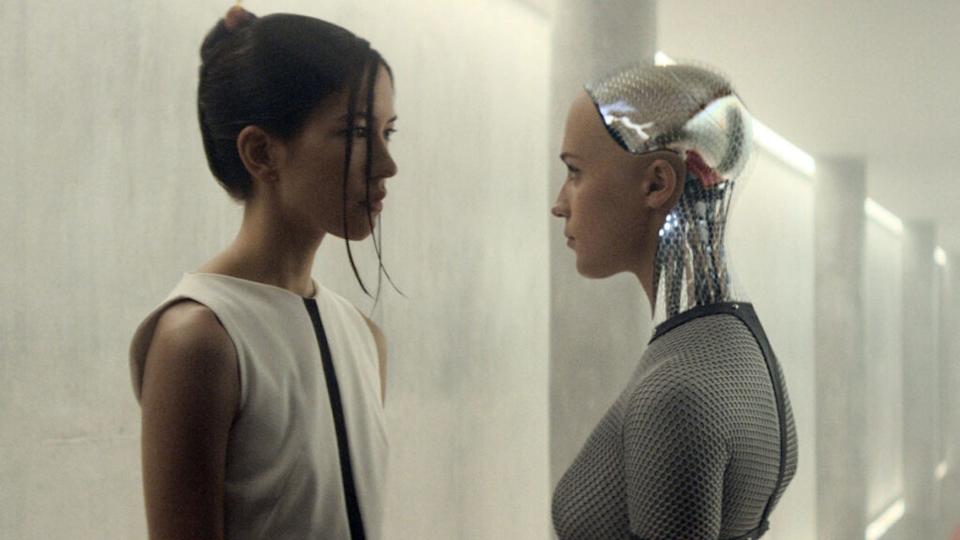
What does it mean to be real in 2025?
In the age of artificial intelligence—where mimicry has become both impressive and terrifying—the concept of being “real” is no longer philosophical. It’s infrastructural. It’s biometric. And it’s for sale.
We used to assume people were people. Now we ask: Is this a bot? Is this a fake? Is this even human? In a world where anything can be generated, realness has become a performance—and a credential.
When Fake Looks Real
We are no longer looking at a future where fakes are clumsy or obvious. That future is behind us.
In 2023, a deepfake video of Ukrainian President Volodymyr Zelensky told citizens to surrender. Millions saw it before it was debunked. In early 2024, robocalls using AI-generated voices impersonated U.S. political candidates in an attempt to influence elections. These weren’t hypothetical threats—they were moments that made entire populations question what they were seeing and hearing.
AI-generated content doesn’t just fool people—it erodes a fundamental social contract: the trust that what you’re perceiving is real. And when that trust dissolves, people don’t just stop believing in images or videos—they start doubting everything.
The panic is not just about what’s fake. It’s about the terrifying possibility that nothing is verifiably real anymore.
Replaced by Code
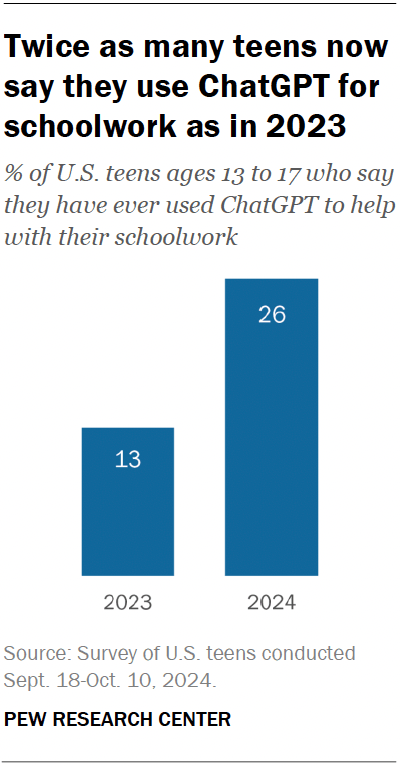
The infiltration of AI into our everyday lives isn’t just about visuals or deepfakes anymore. It’s systemic. Students use ChatGPT to write their essays—sometimes without even understanding the material. Customer support bots mimic empathy with pre-trained scripts. Entire creative departments are being quietly supplemented, or replaced, by generative models. What was once a human process—thinking, feeling, creating—can now be simulated and scaled.
What started as a productivity hack has become something more existential. You can’t outwork a machine that doesn’t need sleep. You can’t out-think a tool trained on the entire internet. Even creativity, long thought to be uniquely human, has entered the age of mass automation.
And speaking personally—being Gen Z, I’ve lived both sides of this shift. I remember what life was like before AI was in our back pocket. We studied for hours. We pulled all-nighters in the library. We wrote 3,000-word essays by hand, paragraph by paragraph, building arguments from scratch and formatting citations manually.
Now? I can write that same essay in a single prompt. I can build an app in less time than it takes to make a cup of coffee. It’s not that I miss the grind—but the speed of creation today feels suspiciously frictionless. The sense of effort is gone. And sometimes, with it, the sense of meaning.
It’s not all bad. I use these tools too—I’d be lying if I said I didn’t enjoy the convenience. But as we lean further into AI, I worry we’re losing something deeper: our patience, our attention spans, our understanding of what’s truly “ours.” The boundary between human output and synthetic creation is thinning. And the scariest part? No one’s quite sure where the line is anymore.
And that’s why, increasingly, being “real” isn’t something you just are. It’s something you have to prove.
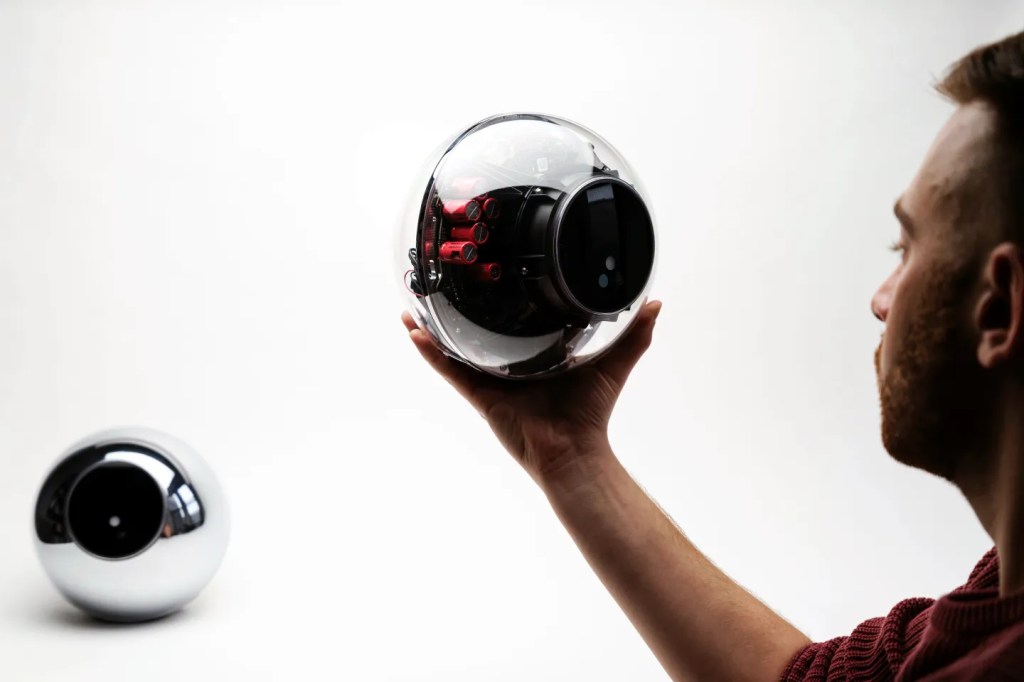
The Orb: Realness as Currency
Enter: Worldcoin. A project that—depending on how you view it—is either a dystopian fever dream or a genius infrastructure shift for the digital age.
At the center of the project is the Orb—a gleaming silver sphere that scans your iris to confirm your humanity. Once scanned, your unique iris pattern is converted into a one-of-a-kind hash—a cryptographic code that’s then stored on a decentralized blockchain. The company promises that your biometric data is not kept, only the hash remains. This hash becomes your digital proof-of-personhood.
Scan your eye. Receive a hash. Get Worldcoin tokens. Welcome to the new economy of identity.
Sam Altman, the face behind both OpenAI and Worldcoin, envisions this system as a foundation for universal basic income—a way to distribute wealth in an AI-dominated future where jobs may vanish. It’s noble in theory. But in practice, it raises questions: Is this really about equity—or about building yet another platform that turns identity into infrastructure? Is your “realness” being protected—or packaged?
The Orb doesn’t just grant access. It extracts value. You become legible to the system. A clean, trackable, tokenized unit in the economy of verified selves.
Your Body, Their Data
But Worldcoin isn’t the beginning of biometric identity—it’s just the most audacious.
Think about it: your body has already become your password.
Face ID unlocks your phone. Your fingerprint authorizes your bank transaction. Your heartbeat and sweat levels are tracked by wearables marketed as wellness tools. We’ve normalized this reality, inch by inch.
But it goes deeper.
Every day, we’re inching closer to a society where even our most private physiological reactions become part of someone’s data pipeline. Galvanic skin response tools—once used for lie detectors—are now embedded in UX testing labs and smart devices, ready to gauge our mood and stress. Facial emotion recognition is showing up in job interviews. Eyetracking tools analyze how long we stare at a product before we click.
Imagine walking into a store and everything you touch or look at triggers a chain reaction. That door handle? A sensor. That smart mirror? Watching your expressions. That display? Adjusted in real time based on how your skin reacts to certain colors. The feedback loop is invisible, but it’s always running.
And it doesn’t stop at the store.
It feels as if we’re already living in the soft glow of a Black Mirror reality—one where every tap, glance, sigh, and scroll is captured not to understand us, but to shape us. Every part of the human experience is being converted into signal, insight, and sale.
Convenience has a cost.
In this system, the more “real” you are—the more intimate your behaviors, emotions, and biometrics—the more valuable you become.
Final Thoughts
We once feared AI would replace creativity. What we didn’t expect is that it would also replace certainty—blurring the lines between authentic and artificial so completely that being human would itself become a status to prove, a resource to extract, and a label to license.
In this world, even reality has a price tag.
And if we’re not careful, we won’t be living in a dystopia—we’ll be subscribing to one.
 the Mirepoix
Leave a comment