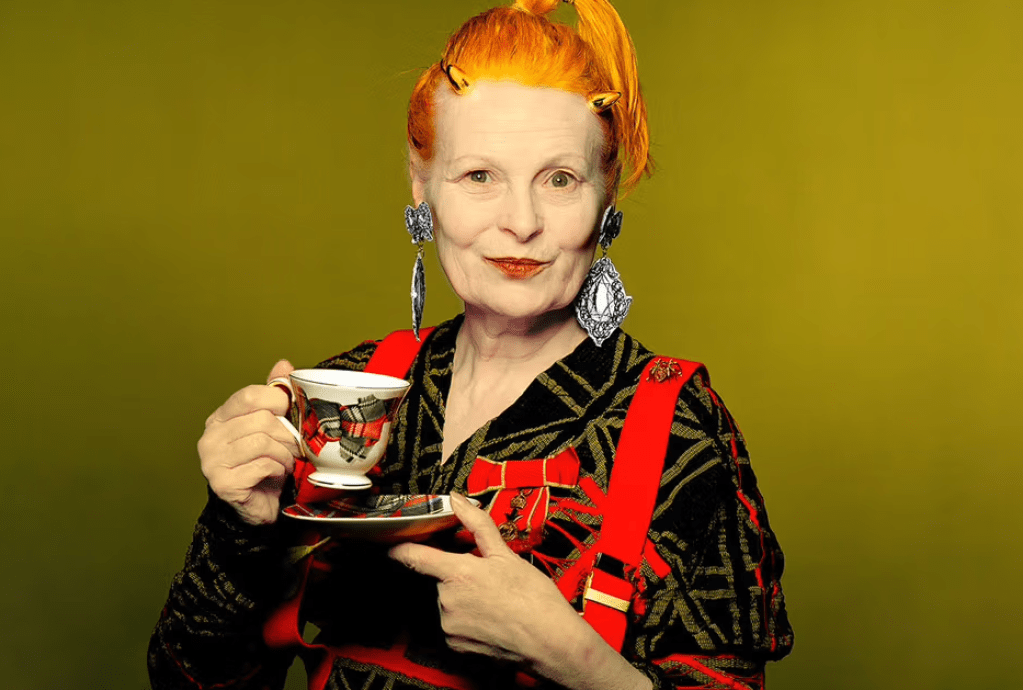
“Popular culture is a contradiction of terms; if it’s popular, it’s not culture. Anything worthwhile is always appreciated by a minority.” — Vivienne Westwood (1996)
I came across this quote from Vivienne Westwood in a 1996 interview while sipping tea and doomscrolling my way through this dreadful winter, trying to survive and maybe even enjoy a bit of the Christmas spirit (because, you know, balance). And let me tell you, it hit me like a ton of bricks. In a world where social media reigns as the new “trend oracle,” fast fashion is on full throttle, and everyone’s scrambling for their 15 seconds of viral fame, luxury brands are at a crossroads: Do they stick to their roots of craftsmanship and exclusivity, or dive headfirst into the hype machine and pray for likes? Let’s unpack this, shall we?
Luxury Brands: How They Came to Be
Many luxury brands gained their status by serving royalty and aristocracy, offering bespoke, high-quality goods that set them apart from regular brands. Hermès, for example, began in 1837 as a saddle maker for French nobles, while Cartier earned the moniker “the jeweler of kings” after crafting coronation tiaras for King Edward VII. Brands like Louis Vuitton, which created luggage for Empress Eugénie, and Balenciaga, revered for its architectural designs for Spanish royalty, established exclusivity and craftsmanship as their hallmarks.
At their core, luxury houses were never merely purveyors of goods—they were pioneers, defined by their superior craftsmanship and distinctive heritage. It wasn’t created for everyone, but for the few who recognized and appreciated the true value of these offerings.
As Vivienne Westwood said, “anything worthwhile is often appreciated by only a select few.” Is there an inherent connection between exclusivity and craftsmanship? or can a brand chase the mass while still remain somewhat “exclusive”?
Case Study: The Rise of Miu Miu
Miu Miu—Prada’s “younger sister”—was once an overlooked entity in the luxury market. However, its transformation into one of the hottest brands of 2024 showcases the power of embracing heritage and a unique vision.
For much of the 2000s, Miu Miu remained on the periphery, with its collections occasionally earning critical acclaim but rarely capturing mainstream attention. Its aesthetic, which blended retro inspiration with an irreverent charm, appealed to a niche audience but lacked the coherence needed to compete with dominant luxury players. However, this niche appeal eventually became its strength, as Miu Miu leaned into its (what I would describe as) “whimsy femininity” – a blend of “endearing eccentricity” meets “awkward chic.” Miu Miu’s brand isn’t about being the polished prom queen; it’s about being the girl who you secretly admired in school—the one who doodled in the margins of her notebooks, wore glasses slightly askew, and had a knack for turning knee socks and loafers into a statement.
The real game-changer came with Miu Miu’s Spring/Summer 2022 collection, which featured a revival of ultra-low-rise micro-mini skirts paired with crop tops and oversized blazers. The looks exuded a nostalgic yet irreverent Y2K vibe, blending the quirky, schoolgirl-like aesthetic Miu Miu was known for with a provocative edge. These micro-minis became an instant viral sensation, appearing on countless celebrities, influencers, and editorials. It wasn’t just a collection—it was a cultural moment seen on every corner of the internet.
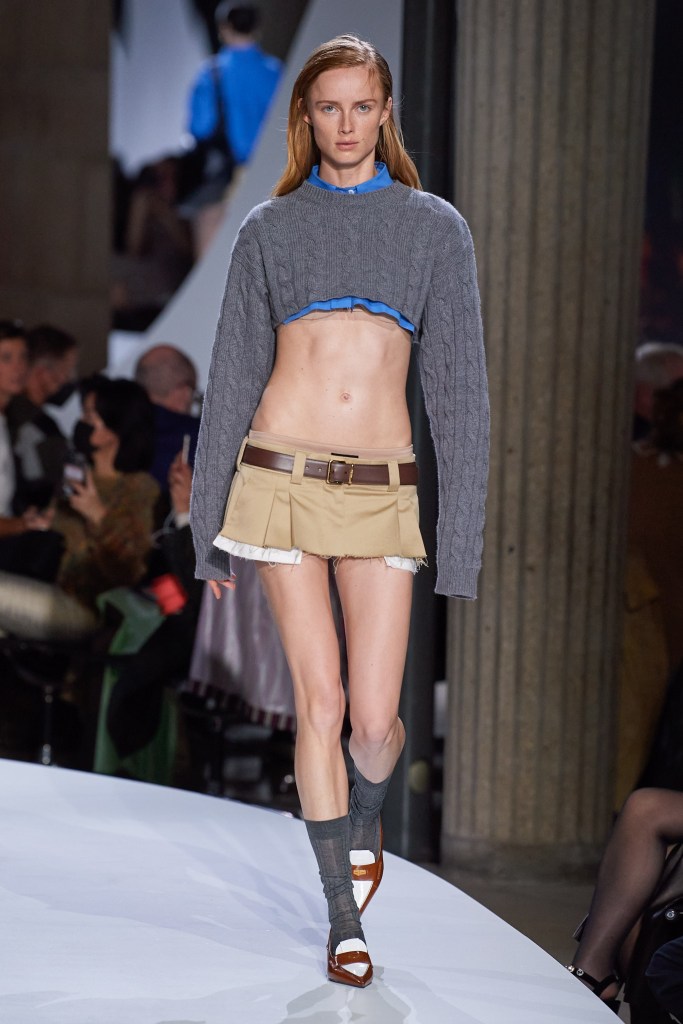
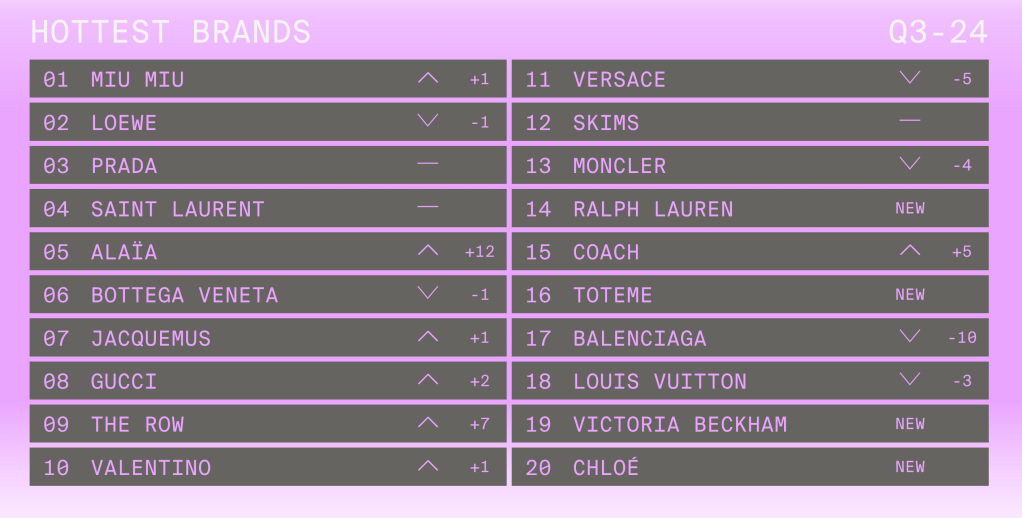
Miu Miu’s rise to the top is a masterclass in how embracing heritage pays off in the long run. While the micro-mini skirt from Spring 2022 set the internet ablaze, the brand didn’t stop there—it stayed true to its quirky, intellectual roots, proving that authenticity has staying power. Even after the viral moment faded, Miu Miu maintained its momentum, holding its position as the hottest brand in fashion according to Lyst’s Q3 2024 report. The secret? Embracing it’s brand identity and heritage.
The so-called “Miu Miu-ification” of fashion isn’t about chasing every fleeting fad; it’s about cultivating an aesthetic so distinct that it feels fresh and familiar at the same time. This stands in stark contrast to brands like Gucci, which have faced backlash for diluting their identity in an attempt to cater to everyone.
Miu Miu’s strategy highlights a critical truth: short-term hype might generate buzz, but long-term success comes from crafting an authentic narrative that resonates deeply with a loyal audience. By leaning into its roots while embracing the zeitgeist selectively, Miu Miu proves that heritage, when nurtured, is the ultimate trend.
Balenciaga as an Exception? The Paradox between Heritage and Trend Chasing
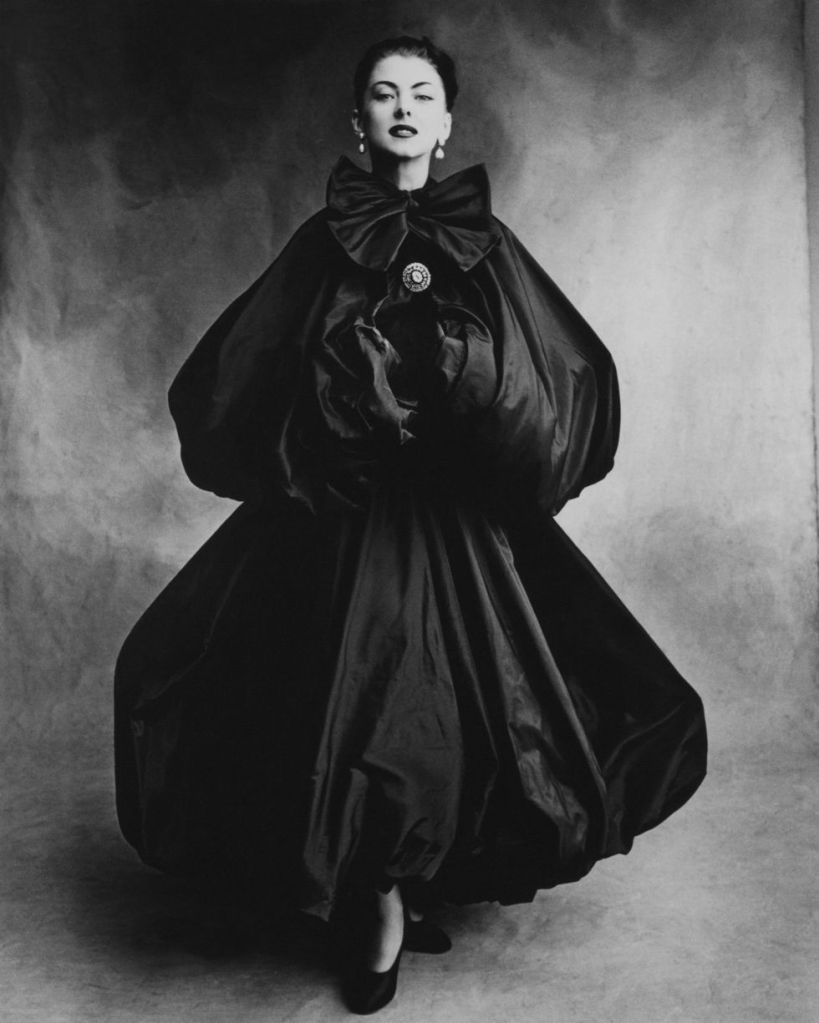
Balenciaga’s evolution is a compelling case study for the luxury brands who’s toying with the idea of legacy vs trend chasing. Founded in 1917 by Cristóbal Balenciaga, the house quickly earned its stripes by revolutionizing fashion with groundbreaking pieces like the cocoon coat and tunic dress, which completely reshaped silhouettes. His relentless commitment to perfection and innovation earned him the admiration of peers such as Coco Chanel, cementing the brand as the epitome of understated elegance and impeccable craftsmanship. But alas, after the closure of his atelier in 1968, the brand went into a deep slumber, marking the end of an era defined by exclusivity and artistry, only to be resurrected decades later.
Fastforward to 2015, when Demna Gvasalia took the reign as creative director, Balenciaga’s image took a sharp detour into uncharted territory. Known for his avant-garde work with Vetements, Demna injected a provocative, streetwear-heavy aesthetic into the brand that sparked equal parts praise and outrage. Under his leadership, Balenciaga didn’t just embrace maximalism—it reveled in it. From platform Crocs to dystopian runway shows, and let’s not forget the $2,000 Ikea tote bag, Balenciaga became a cultural lightning rod. Its every move was scrutinized, its audience split into enthusiastic fanatics and disgruntled critics— welcome to the world of modern day fashion!
Now, let’s be real—this strategy works, at least when it comes to sales. Before Demna’s takeover in 2015, Balenciaga was raking in about €400 million annually. Fast forward a few years, by 2019, Balenciaga was on track to hit the €1 billion mark in revenue for the first time. And by 2022? The brand’s sales soared to a cool $2 billion. Not bad for a brand that regularly gets roasted and cancelled on the internet for its outlandish designs and heavily inappropriate campaigns.
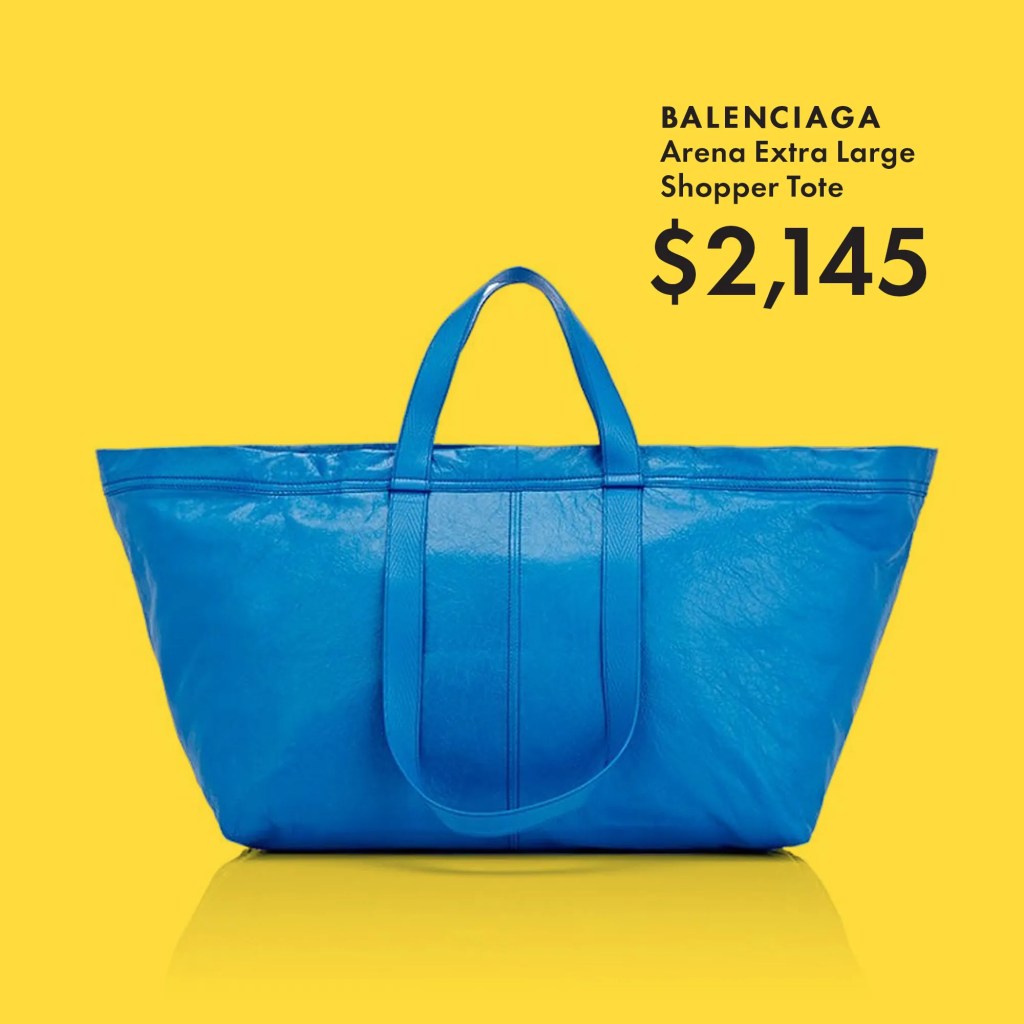
But here’s the real kicker: Is Balenciaga’s trend-chasing truly what’s driving the brand’s success and relevance? If you take a stroll through the streets, you’ll rarely see anyone sporting those “absurd” pieces like the distressed dirty sneakers or the Ikea bag. No, what you’ll mostly spot are Balenciaga’s classic silhouettes: the City bag, the Hourglass bag, and a whole host of other timeless items. Those outrageous creations are nothing more than a calculated strategy to stir the pot and keep the brand relevant in a world where attention spans are shorter than a TikTok video.
Balenciaga’s approach to “clout chasing” is a strategy—to serve up something controversial and shocking to get people in the door (or at least the headlines), and then make sure they leave with something far more practical. It’s risky, it’s bold, but it’s undeniably effective.
Balenciaga has mastered the art of riding the wave of controversy, ensuring that it stays in the spotlight—and makes a tidy profit while doing so. (Feel free to refer back to my last article where I talked about a similar concept – it’s not about the product and art itself, but what kind of reaction it sparks amongst the consumer!)
The Dichotomy of Fashion and Luxury
Fashion is built on trends—the fleeting, the now, the “it” moment. Luxury, however, exists beyond these temporal boundaries, its value rooted in heritage, craftsmanship, and scarcity. The most successful luxury brands understand this fundamental distinction, leveraging their rich histories and expertise to cater not to the masses, but to a discerning few who appreciate quality over quantity.
In a world obsessed with the new, true luxury sets itself apart by remaining grounded in timeless values.
Conclusion
Westwood’s observation acts as a cautionary tale for luxury brands: chasing the spotlight may bring temporary popularity, but lasting cultural relevance—and genuine luxury—is forged in its ability to resonate with a select audience.
The data backs this up. According to Bain & Company’s 2023 luxury market report, brands that stayed true to their heritage and focused on craftsmanship outperformed trend-driven brands by 25% in sales growth over the past year. Hermès, the epitome of artisanal mastery, saw a 15% increase in revenue, while brands like Balenciaga—those that ride the trend wave—saw their numbers dip, thanks to controversies and market fatigue.
In a world that’s obsessed with immediacy and fast-paced trends, brands like Hermès and Miu Miu prove that staying true to your roots—embracing authenticity and a distinct identity—is the secret to long-term success. Because, as we all know, true luxury isn’t made for the masses. And if you lose sight of that, the financial and cultural consequences can be steep
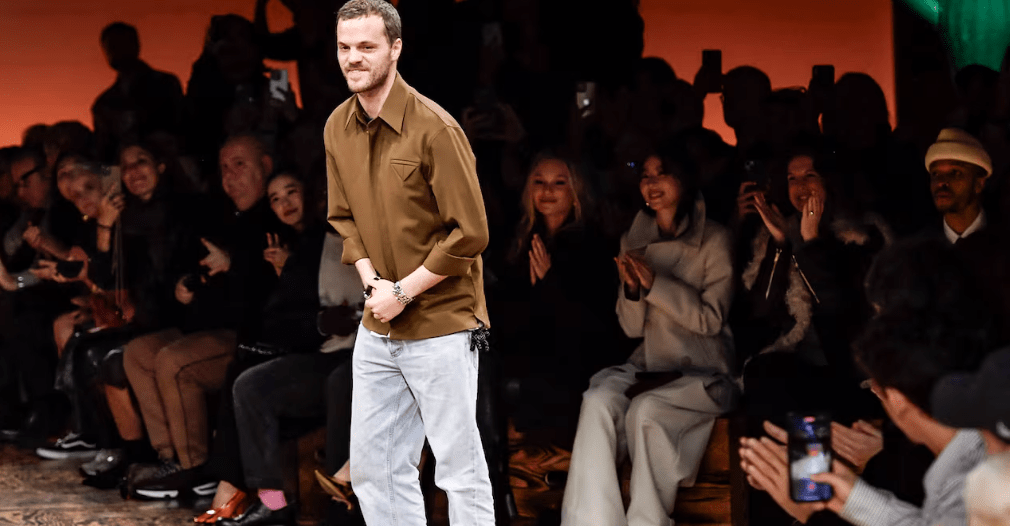
But hey—I do love the thrill of watching things switch up in the fashion world, especially with all the current chaos of creative director roulette. Who doesn’t love a surprise guest like Matthieu Blazy waltzing into the Chanel spotlight? Honestly, it’s about time Chanel shook things up a bit.
 the Mirepoix
Leave a comment